Featured project / Independent development
Hangar Copilot
Connecting maintenance work, technical information, and the mechanic’s judgment.
Find the information. Keep the work in view.
I am building Hangar Copilot for general aviation mechanics and small fleets. It brings aircraft information, maintenance tracking, and task-focused retrieval from uploaded manuals into one workspace.
The problem is familiar from maintenance work: a job can require information spread across task cards, manuals, parts catalogs, and notes. My design goal is to make that information easier to locate and the status of work easier to follow.
Advisory maintenance assistant · Prototype in development
Solo-built project · Maintenance information access · Human–automation interaction
My contribution
I am developing the prototype’s workflow and interface, drawing on my aviation maintenance experience. My contribution connects aircraft-specific task context, technical reference retrieval, maintenance tracking, source visibility, and human review.
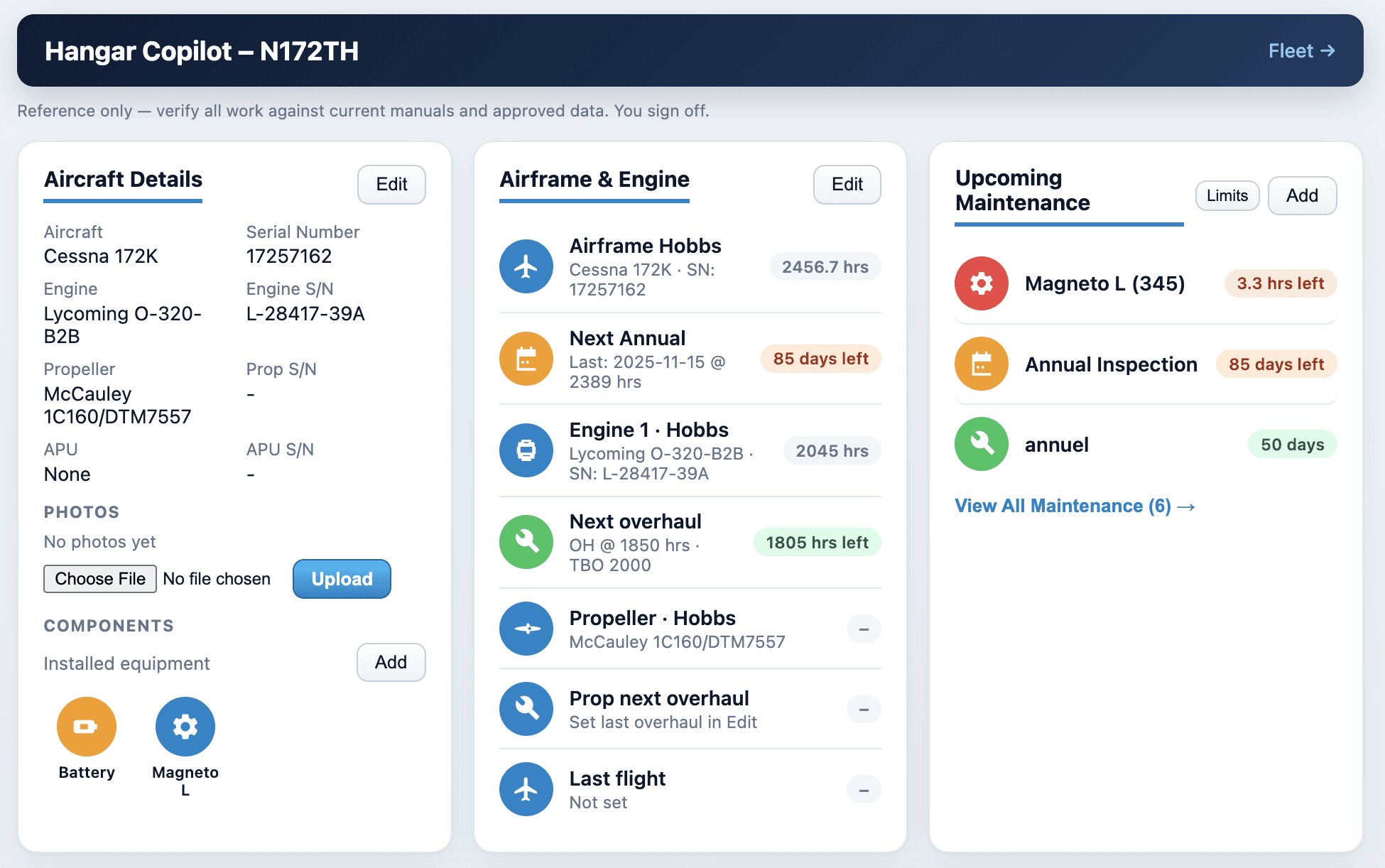
Hangar Copilot interface prototype. One design iteration exploring how to organize aircraft details, operating hours, and upcoming maintenance to support a mechanic’s workflow. This image illustrates an interface under development, not a finished or validated product. Select the image to view it at full size.
01 / Select the aircraft
Aircraft-specific details, manuals, and maintenance status.
02 / Describe the task
Search uploaded maintenance and parts manuals, including related terminology.
03 / Review a task package
Organize the main reference, parts, tools, and task information.
04 / Verify and document
The mechanic checks current source information and completes the official record.
Information retrieval → cognitive support
PDF search and synonym expansion support finding relevant information without requiring the mechanic to know the manual’s exact wording. The intended benefit is less search effort; time savings have not yet been demonstrated here.
Maintenance tracking → visible work status
Upcoming maintenance, discrepancy status, and working history make information available outside memory. Aircraft-specific displays hide equipment that is not installed, keeping the workspace relevant to the selected aircraft.
Source separation → appropriate trust
The design distinguishes manual references from “Shop Wisdom,” which is labeled as personal advice. Working records and draft write-ups remain advisory, with the mechanic responsible for source verification and official documentation.
Editing roles → control over changes
Read-only, basic, and full-access roles define who can change aircraft information and settings. This offers a concrete design example for examining permissions, error prevention, and user control.
Related research / Planned directed study
How do mechanics find controlling information?
My planned IE 7000 directed study examines maintenance-manual information access through a short survey of working A&P mechanics. Topics include paper versus electronic manuals, search burden, and mismatches between task cards and source manuals. The planned output is a descriptive research report. Participant recruitment and data collection are subject to institutional approval.